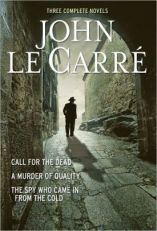
George Smiley Novels – John le Carré created one of the great characters in the spy novel genre in his first efforts. George Smiley debuts in “Call For The Dead” and follows up in “A Murder of Quality”.
 Le Carré is one of the iconic names in espionage fiction. Beginning his writing career while still working in the Intelligence organs of Her Majesty’s government, he offered a different view of the life of a spy. George Smiley holds his own iconic place in the field. Think of Smiley as the anti-Bond. Where Bond is a good-looking man of action to whom women are attracted, Smiley is anything but. Described most often as looking like a frog or a toad, he is a dumpy little man who works in the unglamorous nitty-gritty part of the spy world. There is a beautiful woman in his life. His wife, the serially unfaithful Lady Ann Sperow, was a surprise “conquest”. The common comment here is surprise that such a man could marry such a beauty. Smiley’s devotion to her (in a way Bond rarely touches), makes her repeated, public affairs all the more humiliating. What the two great English spies share is a devotion to country tempered with cynicism and an understanding that cruelty is a necessary weapon in their arsenal.
In the first novel, “Call For The Dead”, we meet Smiley after World War II, and facing issues that arose from his work during the war. One agent he ran has now gone to work for the East Germans. As will be the case throughout his career, George gets the call to clean up a mess, and, if necessary, be the fall guy if things go wrong. He is a man lacking the polish and connections to rise into the politics charged upper echelons of the Service, but he is relentless, thorough and cautious. Thus he is never a threat to his superior’s position, but always a threat to their plans. He is an enigma to them, even if they don’t believe it.
The second novel is a curiosity. It’s not a spy novel at all. Smiley’s connections in the Intelligence world draws him into a classic English murder mystery. But once that story begins, the cloak and dagger world fades into the background. Le Carré brings his hero into another pressurized English sub-culture, the public school. (As always, American readers need to remember that we would call these private schools. Elite academies for the offspring of the various levels of the English upper crust.) Carne is a school whose past is greater than its present. The faculty is a sky filled with lesser lights. The newest member, Mr. Rode, who did not attend a prestigious school growing up. The murder of his wife in their home one winter evening is what brings Smiley to Carne. Set in the country, in a quiet village, there is an undercurrent of deceit and evil here. George has to swim against that current with discretion in search of the answer.
In both cases, (and the ones to follow), Smiley’s world is a gray and gritty place. A world filled with cynicism, deceit, betrayal, and despair. There is less “intelligence” than you might expect. The survival of nations in this murky underworld is more often the result of luck and diligence than it is from high blown political theory or brilliance.
Through it all, Le Carré’s gifts as a storyteller carry us forward. Smiley will lead us into one “long, dark night” after another, but his creator’s touch leads us with sureness through to the end.
I read these two books as part of a three novel collection. The third novel is the classic “The Spy Who Came In From The Cold”. That book launched both the author and the character into the highest echelons of the genre.
Rating – **** Recommended


Leave a Reply