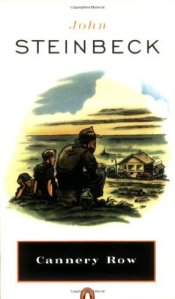
Cannery Row by John Steinbeck (1945) – “Cannery Row in Monterrey in California is a poem, a stink, a grating noise, a quality of light, a tone, a habit, a nostalgia, a dream.”
Welcome to a ragged community that has found a way to care for one another. Mack and the boys are installed at the Palace Flophouse and Grill, across the street from the Western Biological Laboratory where Doc prepared specimens for dissection at schools across the country. Lee Chong runs the local store with a sharp eye to profit and loss, and the Bear Flag Restaurant, which is actually the local brothel, is the social center of the Row. Times are hard on Cannery Row, but the folks do their best.
 Like life on the Row itself, the tempo here is easy. Steinbeck takes it slow. No one is is a rush, because there’s nowhere to rush to. At the heart of it all is Doc, a man of science surrounded by those who hold his education in reverence. Everybody likes Doc, even if they don’t understand him. Meanwhile, Mack and the boys, a group whose number varies, have found a philosophical approach to life. They are not averse to work, but they don’t see it as the be-all and end-all of a man’s life. They work enough, and not a minute more. Around these two poles float Lee Chong, Dora and her girls, a little broken boy named Frankie, frogs and cats, a dog, an old Asian man who passes through each day, and a dead girl in the tidal flats. The Malloys live in an abandoned boiler and rent out space in the pipes and tanks in the lot behind them. They form a unique community.
This is a story about people who live at the edges of society. Set in the closing days of the Depression, the outside world rarely impinges on life along the row. The fishing boats go out empty and return filled with fish for the canneries. Life meanders, but there is a rhythm for the residents here.
Steinbeck offers us a story that is funny and sad. I smile as Lee Chong calculates every outcome of a decision before making the one that will cost him the least and offer the greatest chance at a profit. The same goes for the plans of Mack and the boys. They will think deeply, plan carefully, and know it will all come apart by the end. The language is beautiful and descriptive, setting the mood for the story. The novel encourages you to savor each moment, yet it pulls you along. Like one of Mack’s parties, the novel’s logic is irresistible. Yet, in the end, each resident of this community is alone. That loneliness is central to their lives. It is also the central of the sadness in the story.
For me, Cannery Row itself calls to me. To wander down the street, pausing to pass a word with the bouncer at the Bear Flag, to wander the eclectic aisles of the store, knowing the Lee Chong’s eyes will follow me everywhere I go. Then, with a bottle of “Ol’ Tennis Shoe”, I’d wander up to the Palace, where they would greet me with polite coolness. Finally, I’d take some beer across the street and knock on Doc’s door. There to spend an hour or two discussing the ways of the world outside his windows as classical music played in the background.
I’d never fit into their community, but it’s a place that everyone should visit, at least once. How could you possibly resist a party that had “all the best qualities of a riot and a night on the barricades”?
Rating – ***** Must Read

