Captain Blood (1922) and The Sea Hawk (1915) by Rafael Sabatini
Two romantic adventure novels from the popular Italian-English author. Sabatini scored his first major success with “Scaramouche” in 1921. By then he had written a dozen novels and many short stories over more than twenty years. With the success of “Captain Blood” the following year, they republished all of his previous work, and “The Sea Hawk” became an international bestseller as well.
Sabatini wrote historical fiction. He was dedicated to taking historical events and people and weaving them into his stories. Getting those details right was important to him and bring the ring of authenticity to his storytelling.
There is a balance between adventure and romance in all his novels. That balance is different between these two examples. In “Captain Blood” (also printed under the title “Captain Blood: His Odyssey”) the balance is towards the adventure side. The romance between Blood and Arabella is an important part of the story, most of the action follows, well, the action. In “The Sea Hawk” that balance is the reverse. While there is still action, the romance of Oliver and Rosamonde is the central portion of the story. I enjoyed Blood more than Sea Hawk because of that balance.
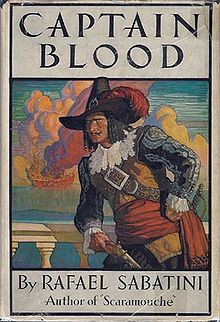
In “Captain Blood”, Peter Blood is an Irish physician trying to settle down in a small English village at the time of the Glorious Revolution against the English king, James II. While Blood has served in the military in Europe, especially at sea, he wants no part of this battle. Unfortunately for him, he is caught up in the battle, convicted of treason at the courts known as the “Bloody Assizes”, sent to Barbados and sold into slavery. He escapes his chains and joins with some real pirates of the Caribbean, rising to great fame. All of this introduces him to Arabella, daughter of the man who bought him at the slave market. Finding a way to survive long enough to return to England, and to the arms of Arabella make up the majority of the story. I enjoyed the story.
The romance between Oliver Tresillion and his beautiful neighbor Rosamond Godolphin. The immediate hurdle is that both the young lady’s brother and her guardian despise Oliver. There are some old family disputes at the center of that dislike. But it is Oliver’s own brother, Lionel, who betrays him. The older brother is kidnapped, and sold into slavery in northern Africa. The captain of the ship hired to pull off this act has some sympathy for Oliver and an even more avarice in his heart. He offers to return Oliver to England for a second fee. Before it can happen, they are captured by a Spanish ship and sold into slavery in Spain. Both Oliver and the captain escape to become pirates with the marauding sails along the Barbary Coast. There Oliver plots his revenge against those who betrayed him. When the romance elements are at their pinnacle (especially the plotting in the Basha’s harem), the story felt slow to me. The rest is more than enough fun to carry the reader along.
There are a couple things to note. The underlying racism of the age is apparent, though not as bad as in some books of the day. Especially in “The Sea Hawk” both Black and Muslim characters are stereotypes. Everyone has their own level of tolerance for this. For the time, the racism is relatively muted.
The other issue for some readers will be the language. While Sabatini was fluent in a range of languages, including English, the language of the age is quite formal in comparison to modern stories. It is the style I would expect from the time and the genre of the books. These are adventure romances, written to appeal to an audience raised in the 30-year period that spanned the beginning of the 20th Century. My advice is to not fight it and go with the flow. The stories are fun. Again, different readers will have different tolerance levels here as well.
So, I enjoyed both books. One more than the other, but by a small margin. Not much “bodice ripping” going on, but plenty of handsome men holding secrets deep in their hearts, along with their devotion to a (often) lost love.
Rating – *** Worth A Look


Leave a Reply