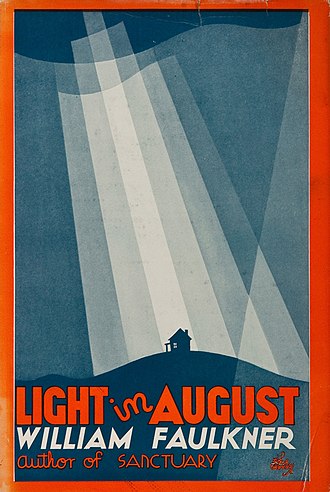
Light in August by William Faulkner (1932). A young woman’s journey to find the father of her child brings her to Jefferson, Mississippi. A house will burn, two people will die, and the echoes of fathers and grandfathers reveal the damage they created.
Faulkner is a writer who went from a critical favorite to forgotten and finally placed at the highest levels of praise in the 20th Century. He is brilliant, challenging, and controversial to some. “Light in August” is not his best known work, but some consider it his best. In the genre of the “southern gothic”, both author and book stand out.
Like noir, southern gothic doesn’t come with a clear definition. The stories take place in the southern parts of the United States. There is a religious/spiritual aspect, characters with deep flaws, all in decayed or grotesque settings. The action often revolves around issues of poverty, violence, ignorance and racism. Works like “The Heart is a Lonely Hunter” by Carson McCullers, “Wise Blood” by Flannery O’Connor, even “To Kill A Mockingbird”, and “A Streetcar Named Desire” often appear on lists of the genre. The emotions are deep and powerful in these stories.
Here, Faulkner weaves many stories together. They all share some connection. Lena is a young woman searching for the father of her child. She is the only person who does not realize that the young man in question does not want to be found. In Jefferson, she will become part of the larger story. There’s Joe Christmas’s self-hatred, the disgraced local preacher’s depression, a grandfather’s hatred for his descendant, and another who overpowers his grandson from beyond death. A fire, a murder (or is it two?), the birth of a child, all tainted with the American “original sin”, racism. Faulkner explores questions of alienation, discrimination, and small-town religion here. Faulkner weaves them together like a cane seat of a chair. They cross and recross each other. It all feels inevitable and without purpose. I could not pull my eyes away.
At the same time, Faulkner is no walk in the park for the reader. He loves language, and all the things he can make it do. His storytelling is complex, his language voluptuous, and his sentence structure requires your full attention. (The Guinness Book of World Records lists a sentence from his “Absolom, Absolom” as the longest proper sentence in the published world. It runs 1,287 words long) Light reading at the beach, this isn’t. Brilliant writing with language that will challenge and envelop you, it is.
“Light In August” is a series of runaway trains, all headed to the same crossing. In Jefferson, Mississippi, those stories collide at full speed. Challenging, brilliant, filled with complex writing telling a byzantine story, Faulkner’s “Light In August” has the power to shake you. An amazing book.
Rating = **** Recommended
 Stories Are My Life
Leave a comment