Struggling Against The Tide
The Winter of Our Discontent by John Steinbeck (1961) – The only remaining valuable part of Ethan Hawley’s long, aristocratic family’s history is the name. His father squandered the family fortune and now his son works as a grocery clerk in his hometown. To regain his self image and the respect of his family, Ethan gambles his integrity in pursuit of a new fortune.
Why I Liked It – Steinbeck’s last novel retains the mastery of language and a deft touch with character.
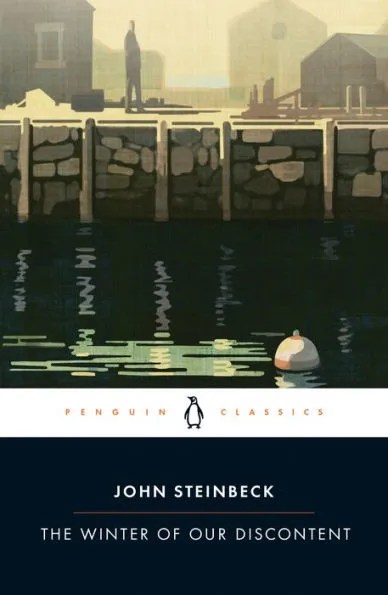
Here’s the book for an age of moral relativism. At one point in the story, Ethan confronts his son for cheating to win a prize, and is told that everybody lies and cheats. He feels no remorse about stealing someone else’s work. It’s in that moment that the father has to face the personal compromises he’s been making. The Hawley family were once among the great and good of Sag Harbor, New York. They’d made a comfortable fortune, though there have always been whispers about how it had been done. Ethan’s grandfather was the dominant figure in his life growing up. The old man was a bit rough around the edges, but gave the boy a solid core of character and integrity. Ethan believes that honesty, integrity and hard work are enough. Yes, some locals pity him, and his wife Mary. Her best friend, Margie, finds him a bit of a challenge. He’s one of the few men in town that haven’t made a pass at her. Friend or not, she’s not letting that challenge pass. Eventually, the pressures push Ethan to a point where he decides that integrity only goes so far. One decision after another leads him to a place he didn’t expect, where he finds an answer literally in his pocket.
I’ve made no secret of my love for Steinbeck’s writing. I respect his ability as a storyteller and a writer. I came across a section near the end of the book that jumped out at me. Ethan and Mary are out for an evening stroll with tension growing between them when this exchange takes place:
“Mary said “Look! There it goes! Did you see it?”
“Where? What?”
“Went right past the tree there and into our yard”
“What was it, Mary? Tell me! What did you see?”
In the dusk I saw her smile, that incredible female smile. It is called wisdom but it isn’t that but rather an understanding that makes wisdom unnecessary.
“You didn’t see anything, Mary”
“I saw a quarrel-but it got away”
I put my arm about her and turned her. “Let’s go around the block before we go in.” We strolled in the tunnel of the night and we didn’t speak again, or need to.”
Steinbeck is flawless in creating that delicate moment when Mary, knowing her husband and what is happening that night, delicately acknowledges the problem and allows it to disappear. It is masterful writing that earned him the Nobel Prize for Literature in 1962. “The Winter of Our Discontent” is usually considered as one of his finest works..
I see no reason to disagree.


Leave a Reply