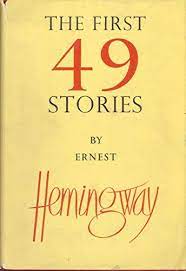
The Short Stories by Ernest Hemingway (1938) is a collection of 49 short stories by the American master. They cover Hemingway’s career from his early days as a war correspondent to the full bloom of his distinctive and influential style. The original publication, “The Fifth Column and The First Forty-Nine stories, Hemingway’s only play, “The Fifth Column.” The version I read is short stories only. From them shines the brilliance that marks him as one of and perhaps THE greatest American author of the Twentieth Century.
Readers and scholars are divided on any author you can name. But I can not think of another author that creates as much polarized reaction as Ernest Hemingway. Some praise his writing style and its impact on American literature, while others criticize his alcoholism, womanizing, and love for blood sports. All of it makes Hemingway the pivotal literary figure in American writing that he is.
The power of his writing is undeniable. From the first word, Hemingway trims the stories down to the bare essentials. He leaves those parts for the reader to fill in. In the brilliant “Hills Like White Elephants”, the central subject is never mentioned. The topic was a hardline taboo for writers, as well as in polite conversation (abortion). The young man and woman edge around the topic, and their feelings about it. There was a moment of heartbreak for me when the reality dawned on me. His peculiar, insistent conversation. Her final request that he “…please please please please please please please stop talking?” (That’s the original punctuation). This is part of Hemingway’s “Iceberg Principle”. He believed stories could be strengthened by leaving out key ideas. That the reader can and should be able to understand those concepts based on what is in the story. The reader has to listen, watch, and think about the people in the stories. In its simplicity, the story becomes more challenging for the reader. In “The Short Happy Life of Francis Macomber” he leaves the reader to determine several things. Who is to blame for all the things that go on? Which is worse, the husband’s cowardice, the guide’s indifference, or the wife’s callousness? Finally, how does the title character die? It’s enthralling as you wind your way through all the failures of character that are the spine of the story.
There are several stories that became the basis for movies here. “The Snows of Kilimanjaro”, and “The Killers” jumped out at me immediately. Kilimanjaro was fabulously successful. This despite the fact the movie got a “Hollywood ending” rather than Hemingway’s original. The story of a man dying in Africa with a fractured marriage resembles “Macomber” but is the mirror opposite of the story. “The Killers” is less well-known today, which is unfortunate. A critical and commercial success (four Oscar nominations); the movie takes even more liberties with the original story. But Hemingway liked it better. It retains the noir ethos of the original story. The story of a man who doesn’t resist being assassinated is stunning.
There is the recurring character in many of the stories of Nick Adams. Adams is considered a semi-autobiographical representation of Hemingway. We follow him through the horrors of the Great War, wandering through Europe, falling in and out of love, and finally, as a father himself.
If you’re a Hemingway fan, you’ve probably read some or all of these early classics. I’ve dabbled with some of his novels, but wanted to dive a little deeper into my beloved short story format. This can be a great introduction to anyone who is a Hemingway newbie. Pick and choose, bounce around. The adventure awaits you.
Rating – * Highest Recommendation
 Stories Are My Life