Holmes In Life
Conan Doyle For The Defense: How Sherlock Holmes’s Creator Turned Real-Life Detective and Freed a Man Wrongly Imprisoned for Murder by Margalit Fox (2018) – The true story of a sensational British murder, a quest for justice and the world’s most famous detective writer.
Why I Like It – A perfect combination of classic Holmesian sleuthing and true crime thriller.
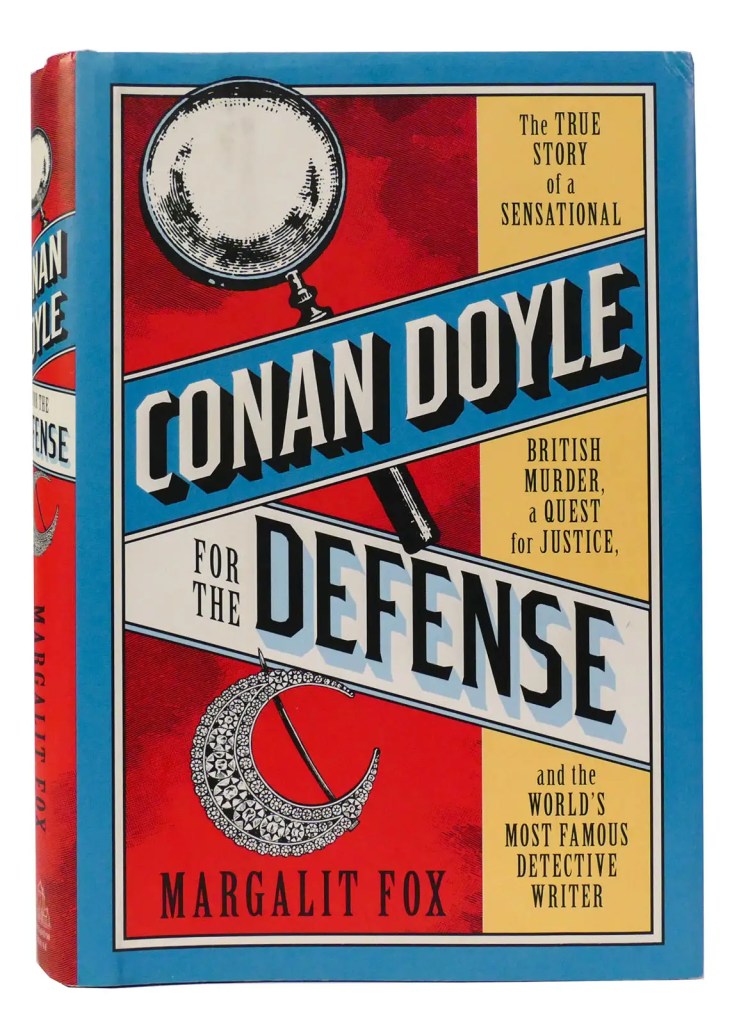
I am a devoted fan of the Sherlock Holmes stories written by Sir Arthur Conan Doyle. I’ve read them all several times, and even had the privilege of teaching one in class (“A Scandal in Bohemia”). Conan Doyle built on the foundation of Edgar Allan Poe’s C. Auguste Dupin stories, the greatest of all the detectives in fiction. Over a century later, the stories still fascinate us. Television and movie interpretations (both good and bad), parodies and homages in print, all continue into the 21st century. Behind the fictional genius stands an equally fascinating creator.
Arthur Conan Doyle achieved a level of fame few others can match. Raised in a home with an alcoholic, mentally ill father, Arthur Conan Doyle was the second of seven surviving children. He grew up to study medicine in Edinburgh under Joseph Bell, upon whom he would base the great detective. Conan Doyle’s career would include time as the doctor on a whaling ship, serving in Africa, as an ophthalmologist (which was a new discovery for me), and as a literary icon.
The story here is from later in life. The author was often mistaken for his creation. This was especially annoying since Conan Doyle grew tired of Holmes, killing the character off, only to have his audience demand the return of the world’s leading consulting detective. There were several occasions when he agreed to use his mental skills to find justice for people who were unjustly convicted. None were more sensation than that of Oscar Slater.
Slater was a German Jew with a history of what Edwardian England saw as an “immoral lifestyle”. As such, he was easy prey for the police as they searched for the murderer of a wealthy old woman in Glasgow. Slater had no contact with the victim at any time, leading up to the brutal murder of Marion Gilchrist. She was an unpleasant woman by all accounts, and fearful of being robbed. The door to her apartment had not one, but three locks on it. Someone gained entrance to the second-floor apartment, took a single diamond pendant, and beat the old woman savagely. Glasgow society wanted a solution, and they wanted one quickly. The police provided Oscar Slater. They tried him on the thinnest of evidence, convicted him, and sentenced him to hang. Public outcry forced His Majesty’s government to commute the sentence to life at hard labor. Oscar Slater might easily have spent the rest of his life breaking granite rocks in the worst prison in Scotland if it weren’t for the intervention of Sir Arthur Conan Doyle.
Margalit Fox, a senior writer at the New York Times, masterfully weaves the stories together (because there are several told here). For the Holmes fan, there is an in-depth look at the man who created the detective, and how he used the very techniques of his fictional character in real life. It gave me a deeper feeling for who Conan Doyle was. The book also shows how pivotal Holmes was culturally. The world was moving into the modern era, not always with great grace. Sherlock Holmes embodies many of the battling forces of past and future of his society. Meanwhile, for the true crime fans, here is a spectacular investigation of a crime most of us don’t know. A horrific murder, a suspect who proclaims his innocence almost to the gallows (in a society that did not have an appeals process!), years in a prison that was as close to hell as any of us would wish to experience, and a decades long fight to find the truth. Fox does a brilliant job finding a storytelling framework that can handle it all.
There’s plenty for readers to relish here. A story that stands at the crossroads of fiction and nonfiction. It’s a story vividly told and with every crystalline detail on display.
Rating – **** Recommended


Leave a Reply