Fer-de-Lance by Rex Stout (1934) – Two deaths appear to have nothing in common. Except to Nero Wolfe, the brilliant and eccentric detective who solves mysteries without leaving his comfortable home. An immigrant metal worker is stabbed, while a respected college president collapses on a golf course, his death ruled a heart attack. The truth is, these deaths are not only linked, but not what they appear. With the help of his “man of action” Archie Goodwin, Wolfe will solve the mysteries without ever missing a meal, his beer, or time with ten thousand orchids on his roof.
Why I Liked It (Them) – A unique addition to the stable of eccentric geniuses.
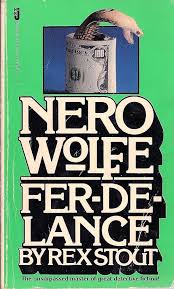
Nero Wolfe may be the greatest fictional detective of the twentieth century with the lowest profile among the modern mystery fan demographic. This is his debut, and the stories would continue into the 1970s. By the time of Rex Stout’s death in 1977, he would have more titles in print than any other living author. Wolfe was a well-known character, beloved, and selling strongly decades into his run. So why does it feel like he may be almost forgotten among the great detectives today?
The most obvious reason is that there are almost no on-screen interpretations of the character. Stout had sold the rights to a couple of titles to a movie studio in the 1950s, but the results had been borderline at best. There were no television versions for the simple reason that the author hated the medium. It’s only after his death that TV got a shot at Wolfe. The network thought so little of a made for television movie they shelved it for two years. In 1981, NBC offered a series that ran for only fourteen episodes. No one tried again till 2001, when the cable network A&E aired twenty total episodes over two seasons.
The stumbling block for these attempts is the detective himself. Weighing in somewhere near 300 pounds, he never leaves his home unless forced to do so. Wolfe doesn’t like people, and deals with them only as required by the needs of his bank account. He does not suffer fools, can be abrupt, and is unwilling to diverge from his daily routine for anyone. Most people find him arrogant and nearly insufferable. He not only thinks he’s smarter than almost everyone else, he unapologetically proves it. In comparison, Sherlock Holmes is a party animal and Poirot, a social butterfly. Finding the right actor, both physically and with the talent to pull this off, has proven to be almost impossible. The made for television movie and the NBC series tried to land Orson Welles for the role, but failed both times. I can not think of another actor, alive at that time, who could have done it. Sydney Greenstreet would have been perfect, but died in 1954. Both series were OK, although the folks at NBC failed massively by trying to “update” the stories.
It’s an almost impossible challenge. Thus, we must remain with the books at the moment.
In the character’s debut appearance, all the unique traits that make Wolfe a classic of the genre are on full display. He lives in a brownstone on the west side of New York. On the roof is a greenhouse where Wolfe’s “concubines” live, ten thousand rare and beautiful orchids. He spends two hours in the morning with them, and two more in the late afternoon. Only issues of life or death disturb those times. His meals are the creation of his brilliant, live-in chef, Fritz Brenner. Business is never discussed at the table, and only rarely while he is having breakfast in bed. According to Archie Goodwin’s various descriptions, Wolfe weighs somewhere between just shy of 300 pounds, and a “seventh of a ton”. Wolfe has only found a few chairs in which he can sit comfortably. All of them are in his house. The house he never leaves unless the situation forces it upon him. He distrusts all machines, most especially cars and trains. Goodwin goes out, looks at things, talks to people, rattles cages, and then returns to the office of Nero Wolfe to report it all. From that, the great detective issues orders, invites people in to speak with him and reveals the truth. Any fan of the stories knows I’ve only scratched the surface of the detective’s eccentricities. It’s an amazing array of stories that overcome serious obstacles for any other storyteller. Rex Stout is worthy of his own movie.
In “Fer-de-Lance”, Wolfe has to overcome the social hierarchy of his day, family secrets, and official agencies (police and prosecutors) who will let things slide because of the victim’s social standing. To find the truth, he will do whatever is needed (within the bounds of his routine), even to the point of inviting four teenage boys to join him for lunch!
I’ve been a huge Wolfe fan for decades and have read not only all of Stout’s work but the first seven novels by Robert Goldsborough (authorized by the Stout estate). He does a nice job of maintaining the feel of the original. I haven’t read his prequel novels. These are on top of the original 33 novels, and 41 short stories and novellas. For lovers of the detective genre, it’s a rare and wonderful trove of mystery and delight. Along the way, there are mysteries to solve, desperate moments to face, including the betrayal of a member of Wolfe’s inner circle.
“Fer-de-Lance” launched a brilliant new star into the detective universe. It remains burning bright, and is well worth discovery, if you’ve never read them. For those already in the know, they are wonderful touchstones. And maybe someday, they’ll find an actor big enough to portray him on the screen.
Five stars – Highest Recommendation
 Stories Are My Life
Leave a comment