Absence of Malice (1981) – A naïve reporter is tricked into spreading a story about an investigation of Mike Gallagher, a Miami businessman and son of a late mobster. There is no basis to the story, but the impact on Gallagher is profound. He has to find a way to clear his name and maybe get some revenge on the prosecutor who set the wheels in motion.
Directed by Sidney Pollack
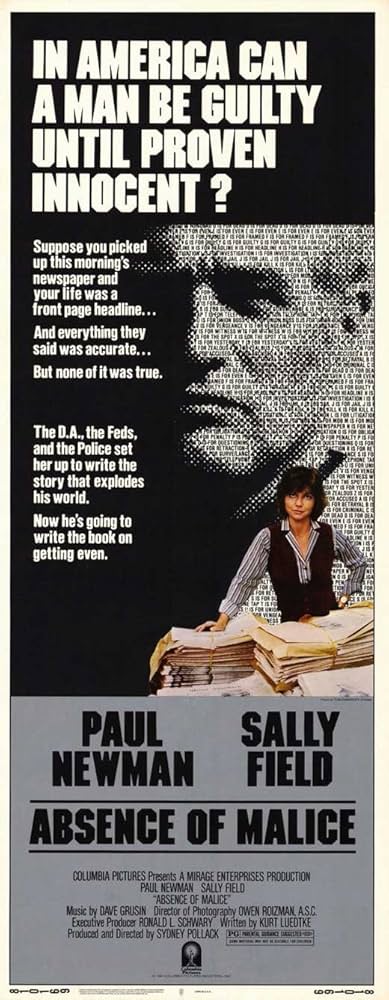
Starring Paul Newman, Sally Field, Bob Balaban, Melinda Dillon, Wilford Brimley
Why I Liked It – Good cast struggle through a story on a difficult point of law.
In 1964, the Supreme Court of the United States ruled that the New York Times did not defame Montgomery, Alabama, police commissioner L. B. Sullivan. The case is a linchpin in protecting the First Amendment rights of the press to report on the actions of public figures. The ruling extended the concept that in order to be defamed, what is published is not only untrue, but that the publication KNEW it was false. If the publication did NOT know, if it was “absent of malice”, then there was no defamation. The ruling makes it difficult in the extreme for a public figure to win a defamation case in the United States.
That’s the basis of the story here. A newspaper story says Mike Gallagher (Newman) may be connected to the murder of a popular union leader. The charge is false, but the leading prosecutor of the task force looking into that death (Balaban) thinks Gallagher knows something or someone who can help. So, he leaves a file where a young reporter, Megan Carter (Fields), can see it. It’s the story that could advance her career, and she convinces her editor to publish it. That starts a chain reaction of events that includes the suicide of an innocent woman.
I’m divided on this movie. The cast is fine; the director is perfect for this kind of story. But the story itself is a legal drama that never enters a courtroom. This movie was personal for Newman because he’d been victimized by publications using the Sullivan ruling to print nonsense about him. The downside of the ruling is that a less than scrupulous publication can fail to do due diligence (or fail to do it well) and then hide behind the “absence of malice” protection. The Carter character fails to do anything beyond the most basic research into the charges. “Absence of Malice” has been called “…the flip side of ‘All the President’s Men’.” (Variety). There, Woodward and Bernstein tracked down multiple confirmations of any accusation. Here, they try to call people for confirmation, and then shrug if they get nothing. I found that distracting and disturbing.
On the other hand, the movie received three Oscar nominations, one each for Newman (Best Actor, Leading Role), Melinda Dillon (Best Actress, Supporting Role), and Best Writing. Dillon is great as Gallagher’s fragile, lifelong friend whose life is destroyed by the stories published. A special nod to Wilford Brimley as the Department of Justice attorney sent in at the end to clean things up. A classic role for him.
Where does that leave me? Newman, Dillon, and Brimley are top flight in their roles. Fields isn’t given a lot to work with here. Megan Carter is a cute young reporter who thinks she can play “the game” but is hopelessly over her head. Most of the movie is talking, but it also has one stunning scene of raw anger and violence. It looks real because it was. Fields was injured during the filming. Brimley’s scene at the end covers about fifteen minutes and is the best part of the whole movie. The rest of the cast and story are mostly forgettable.
But the good parts are pretty darn good.
You can stream “Absence of Malice” on
Rating *** Worth A Look
 Stories Are My Life
Leave a comment