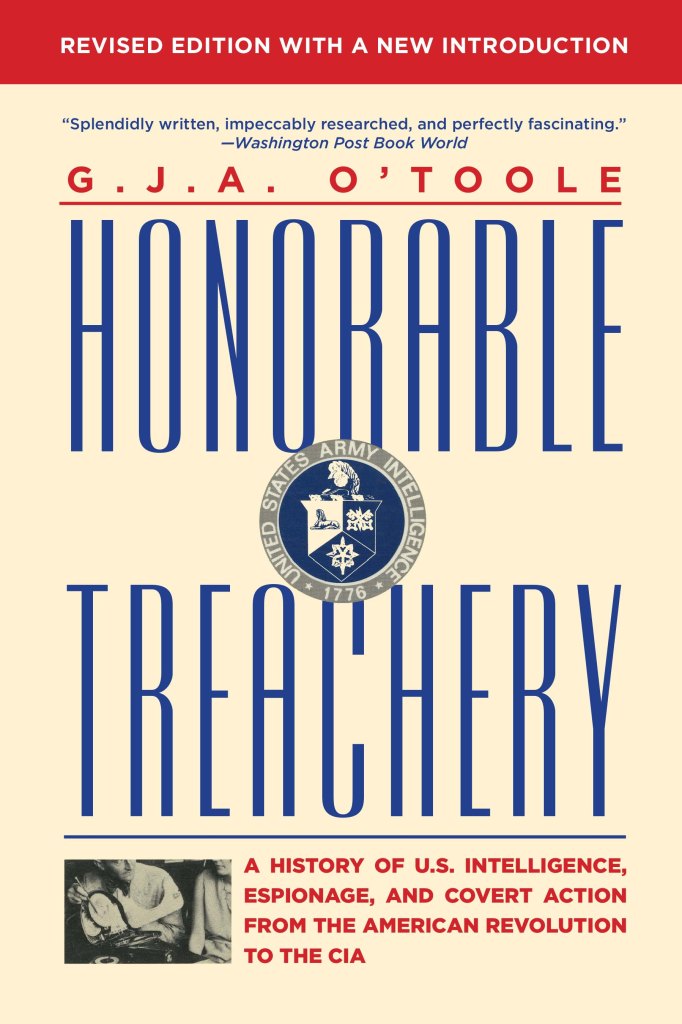
Honorable Treachery- A History of U. S. Intelligence, Espionage, and Covert Action from the American Revolution to the CIA (2014) by J.G.A. O’Toole
An in-depth look at the history of intelligence in the history of the United States. The book begins with the action leading up to the Revolutionary War and carries the story through the age of “central intelligence” in the 1960s.
Why I Liked It – The book is both detailed history and a well-told story.
The people and government of the United States have a divided relationship with the idea of espionage and intelligence. Not so much divided between the two groups, though that certainly exists, but over the value of the concept in total. Success or failure in the military and/or diplomatic sphere is often at the mercy of the information given to the people in charge. A lack of information or, even worse, incorrect information cripples the possibility of success. As a consequence, the nation did not establish any form of ongoing intelligence gathering organizations until the 20th Century, and even those were hamstrung during times of “peace”. It’s the same pattern that the U.S. used with the overall military during the first one hundred fifty-plus years of our history. There is an historical suspicion of standing military bodies. That pattern continued until the end of the Second World War.
This left the young nation without an ongoing corporate memory. Intelligence organizations (by which I refer to both espionage and counter-espionage efforts) were built up once the need was already established. When the conflict was over, all of it was shut down once again. Add into that the establishment distaste for this kind of work (remember the words attributed to Secretary of State Henry Stimson concerning the closure of intelligence agencies following the First World War: “Gentlemen don’t read each other’s mail”). The inevitable result was an American lack of preparation for the events to come in the 15 years that followed.
O’Toole takes us from the Committees of Correspondence that worked against British rule prior to the American Revolution through the establishment of a permanent intelligence community in the two decades following the Second World War. The successes and failures of American intelligence are presented equally and clearly. As are the more dramatic attempts of espionage against the nation. The well-known names are here, like Ethan Hale and Capt. Andre, but there are many, many lesser names. For most of our history, intelligence was in the hands of amateurs and dilettantes. Done from patriotism, a sense of duty, or for personal gain. Some, like Union spy Elizabeth Van Lew of Richmond, were very successful. Others, like detective agency founder Allan Pinkerton, were less so. Pinkerton consistently over-estimated (often by a large percentage) the number of Confederate troops facing General McClellan during the Peninsular Campaign. Not helpful given the general’s already cautious approach!
What I enjoyed about the book was that I could approach it as either a scholarly view of the subject or as a well-told story. For those interested in all the history detail, the book’s use of footnotes is extensive. But you won’t miss anything in the overall tale if you skip them and stay with the story. Even better, the book breaks the history down into “eras” that allowed me to read, set the book aside to think about it, then pick it back up easily. A great read for history and espionage readers.
Rating – **** Recommended


Leave a Reply