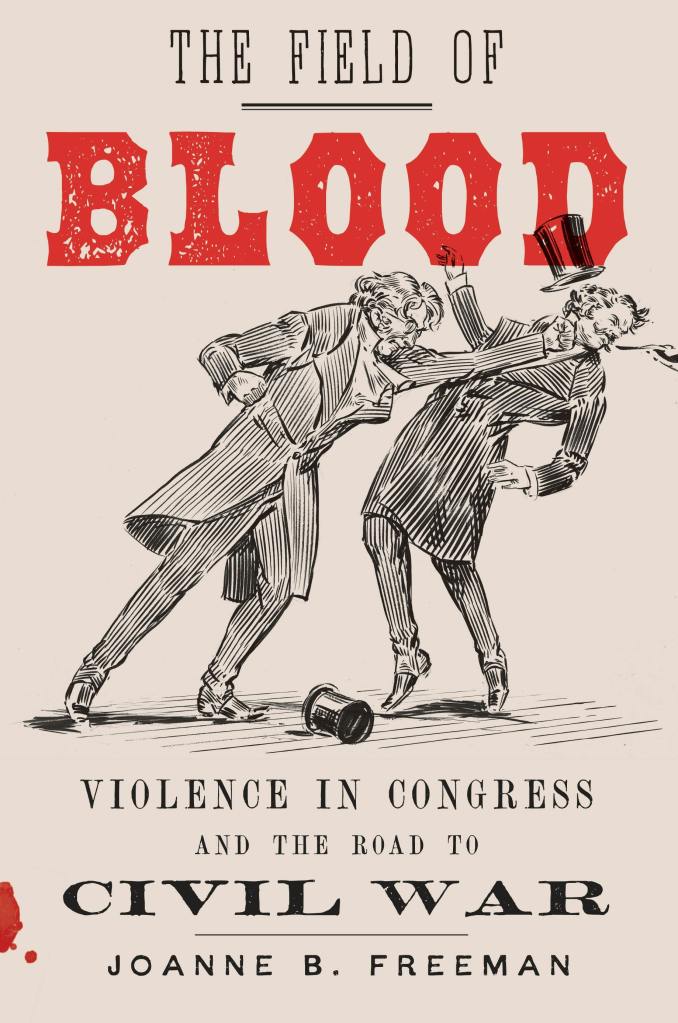
The Field of Blood-Violence in Congress and the Road to Civil War by Joanne Freeman (2018) – A look at violence within the halls of Congress and the streets of our nation’s capitol in the decades leading to the shelling of Fort Sumter and beyond. The divisions that would push the Union to the breaking point began in the decades before. It’s a history of personal violence and death that most Americans know nothing about.
Why I Liked It – It’s a history book that hits all my buttons. History that I did not know, with deep foundations of sources, and an easily read writing style.
As we live through a moment of profound dysfunction in our government, it’s easy to feel that our country has never been worse off. The good news is that it isn’t true. I was thunderstruck by the history revealed through the careful research and storytelling of Joanne Freeman in this book. The bad news is that the current administration seems hellbent on having its own “hold my beer” moment in the race to the cesspool of national history.
Freeman is a history professor at Harvard University with a focus on the political culture and history of the first part of our national history. What she has created here is a book that should be required reading by anyone and everyone concerned about the future of our country in the 21st century.
What I found most stunning is how similar the times are between then and now. The other stunning aspect is how much of the stories she unfolds were utterly unknown to me. My bet is that for most of us the idea of violence in Congress is limited to a vague memory of some congressman being beaten on the floor of the Capitol. Charles Sumner was beaten savagely at his desk in the Senate, almost fatally. That’s horrible enough history, but the truth is that it was only a small portion of the anger and hatred that was a daily part of the government in those years. Members of Congress wore guns and knives onto the floors of the two houses, and drew them to threaten members of the opposition. The political culture of the southern states resulted in verbal abuse of an intensity that is stunning. It’s linked with threats of, and actual physical violence; plus public humiliation of political opponents. While the government completed the regular business of the nation, the resulting distortion of attitudes toward government would lead to the bloodshed of the 1860s. That violence spread beyond Washington, D.C. to politics down to the local level.
All this is revealed through the person of someone I am certain no one other than historians and Congressional history nerds (said with all due respect) have ever heard of: Benjamin Brown French. French would eventually rise to the position of Clerk of the House of Representatives. In that position, he saw and heard everything that transpired. From his diary we get an insider’s understanding of the whos, the whats and the whys of the workings of our government. French was familiar to everyone in the House and knew at least one President pretty well. His words provide the framework for the story that Freeman constructs in this book.
I could go on and on about the stories and characters that struck me. The Cilley-Graves duel, which resulted in the killing of one member of Congress by another. The three northern Senators who finally drew a line in the sand and said they would fight to the death anyone who dared continue the abuse. A President who left broad hints for his followers to continue the violence. Conspiracy theories, intense press coverage (often focused on spectacle rather than the facts), policy conflict, and violence in all forms.
Again, this is a book worth reading. A history worth knowing. A warning from our past that is clearly pointed towards our future.
Rating – **** Recommended


Leave a Reply