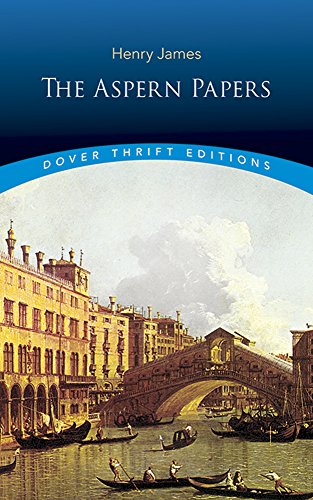
The Aspern Papers by Henry James (1888) – A zealous young editor goes to Venice in search of the legendary final papers of the American poet Jeffrey Aspern. No one knows if they even exist, but he believes that if they do, they are in the possession of Aspern’s muse and mistress, Juliana Bordereau. Through deception and the greed of the old woman, he secures lodging in her home on a minor canal in Venice. From there, he must convince her and/or her browbeaten niece to lead him to the treasure.
Why I Liked It – An interesting story of avarice, deceit, and human relationships.
Over the last decade or so, I’ve been trying to expand my experience of “classic” works and authors. Henry James is another author that I’d never read, and wanted to add to my list. James is a pivotal author in the move toward modernism. This included complex and often obscure motives for his characters. In my research, I saw the title of this novella mentioned repeatedly. There’s an advantage to novellas, in that they give the reader a fuller feeling for the writer’s style without requiring the commitment of a full novel.
So, in I dove.
The story is told in the first person. The young American editor goes unnamed (in one movie version he is called Morton Vint, but the name does not appear in the story), so we live inside his head as the tale progresses. He’s eager to find these papers, which may contain the last unpublished poems of the once famous Aspern. There are gaps surrounding Aspern. There are very few images of him from his prime. He did not write a great deal, and has rather fallen out of the limelight at the time of the story. The young editor is a devotee, however. He refers to Aspern as “a god” and “divine”. Finding these papers, if they exist, is the most important thing he can imagine in that moment. And that leads him to a slowly increasing number of deceptions.
Legend has it that Ms. Bordereau was not treated well by the poet when their affair ended. She was a young woman and carried with her some anger from those days. Her villa is decaying under the burden of its years in the same way as the lady of the house. She lives with her spinster niece, Miss Tita. (Side note: under the standards of the day in the early 1800s, the term “spinster” could apply to a woman as young as her late twenties. By that age, she would be considered unlikely/undesirable as a marriage candidate) The narrator tries everything he can imagine, at times at great cost, to get what he wants from one or the other of the women.
The tempo of this story is steady. I won’t say there isn’t any excitement because the finale comes with not one but two climaxes. There is a certain satisfaction for me in the final solution as well.
Rating – *** Worth A Look


Leave a Reply