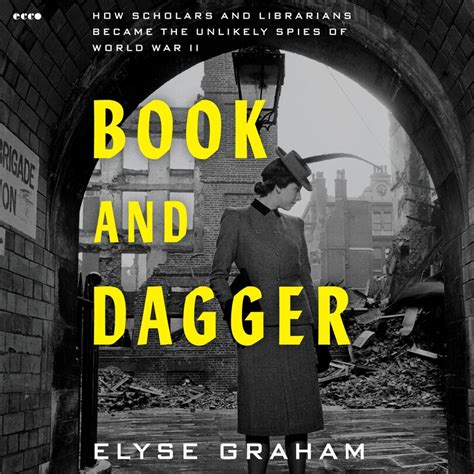
Book and Dagger-How Scholars And Librarians Became The Unlikely Spies of World War II by Elyse Graham (2024) – Drawn from declassified documents from official sources, and many personal documents of those involved, the author details the input of a wide range of non-professional spies who played vital roles in the Allies victory in Europe.
The stories of places like Bletchely Park and organizations like the OSS always include a nod to the bright and somewhat eccentric folks who were essential to winning the war. Here we have a deeper dive into the individuals at the next layer down. The academics who went out and gathered the information needed for the Allies to turn the tide against the fascist forces.
Why I Liked It: Careful history that is told in a conversational tone, like friends sharing stories (really good, detailed stories!) over a drink or meal.
I’ve read a fair bit on the espionage of the Second World War. Especially in the United States, the intelligence community was not as ready as it might have been for the war. Following “The War to End All Wars”, the U.S. shut down virtually the entire intelligence service. All that remained were small military agencies. As war arrived, the realization dawned that all the Allied agencies were far short of the information required. Here’s an example from the book. At the beginning of the American entry into the war, they discovered that there were a grand total of THREE complete maps of the islands that make up Japan. And none of them were in the government’s possession.
What was needed was information both esoteric (military and government policy for our enemies) and mundane (popular opinion, news about the towns and villages, and industry). Also in desperate need were people who understood not only the individual data groups but how they stitched together to see the larger picture. The English were much better at this (though not without their own issues), but the Americans were a mess. In the early days of recruiting and training, an appallingly high percentage of the trainers drew on fiction for techniques. They taught what they’d read in spy novels. What emerged was an intelligence community that could predict the enemy’s actions before they happened and understood the landscape around the world far better.
At the center of it all were people who got very little respect outside their own professional circles. That, it turned out, was the reason for their success. Quoting from the book (page 173):
“Small groups of people really can change the world. Call it the power of small numbers: the unreasonable, improbably, wonderful ability of small groups of outsiders to challenge huge powers precisely because they have strengths that those powers see as weakness…Hitler…despised intellectuals, regarding any career that entailed digging through libraries as particularly pointless. But that type of thinking was why the very people Hitler’s Reich sought to exclude or destroy were singularly equipped to defeat him.”
Male, female, high-minded idealists and humble librarians. Not all were brilliant human beings. One Carleton Coon lived in a fantasy that he was one of those fictional espionage heroes. He was an anthropologist with firmly racist ideas about humanity. He also offered to help found an assassination squad with him at its head. It would allow scholars to direct an unruly public through violence. The director of the OSS, William Donovan, refused to reply to the suggestion.
All these stories are delivered in a conversational style that still offers carefully documented history along the way. I really enjoyed the book, and the additional background on the intelligence services that served the Allies so well in destroying the fascist forces in the war. The result is a book that I think will please both the historian and the casual reader.
Rating – **** Recommended


Hi Jay,
Maps- and not having maps- this is a bit crazy, given that Roosevelt certainly was preparing us to join WWII before Pearl Harbor.
Even so, I remember when the first Iraq war kicked off, the US government went to the National Geographic Society to obtain their maps.
Joanne Brothers
LikeLike
All the results of the Secretary of State’s 1929 decree that gentlemen don’t read each other’s mail.
LikeLike
Haha, I’ve heard of that and I remember reading somewhere that ‘people have friends, countries have interests’
Here’s hoping we soon have an administration that cares about our interests and not just those of the oligarchs.
LikeLike