I wanted to write this last month after the news of Jim Bouton’s death was announced. But the deal I had made with myself was that I would start in August. That I wouldn’t dribble slowly into the return to my work here. A clean start, which I have now achieved.
So a moment to remember one of the books that changed how I saw the world.
I become a baseball fan as a boy. In the 1960s, the sports team in Pittsburgh was the Pirates. The Steelers stunk and the Penguins didn’t exist till the end of the decade. There was an attempt to bring pro basketball to the Steel City that never caught fire. I loved playing the game, and the Pirates were my team. The players were these god-like figures beheld only from a distance. The game was “pure”.
It was all a boy’s fantasy, of course. The game had been anything other than pure since its beginning. But all that took place “behind the curtain”. It was never spoken of in polite company. When things like the “Black Sox” scandal happened, everyone acted shocked and pretended that no such thing had ever happened before.
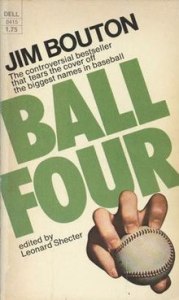 Then Jim Bouton wrote “Ball Four”. It was an intelligent, honest look at life as a big leaguer. Bouton had been a young phenom pitcher with the Yankees for two seasons in the early part of the decade before an arm injury derailed his career. The book documents his 1969 season as a member of the expansion Seatle Pilots, and memories of his life and career. Unlike most baseball writers of the day, Bouton chose not to “sanitize” the poor behavior of many players. Playing on drugs (“greenies”/amphetamines were the drug of choice back then), playing drunk or hungover, sexual promiscuity and marital infidelity were shown to be part of the day to day life in the majors. The traditionalists were appalled. Baseball commissioner Bowie Kuhn tried to brand the book as “detrimental to the game”. The Yankees banished Bouton for years for the offense of not going along with the popular mythology.
Meanwhile, the book became a bestseller and is regarded as the most influential sports book of all time.
And it made me love the game even more.
Bouton didn’t like some of his teammates, but he made all of them human. Mickey Mantle dragging himself to the plate suffering with an enormous hangover, hitting a monster home run, then staggering back to the dugout, noting that the fans had no idea how hard that had been. The book is filled with household names of the day, and folks that no one ever heard of (“Dooley Womack? THE Dooley Womack?”) as he took us behind that curtain.
Over the years, I have re-read the book many times. It’s the only sports books that can make that claim. The baseball landscape of the day is very different than today. Curt Flood wouldn’t win the right to free agency for another couple years. Players were trapped in a system that favored the owners to an almost impossible degree. The dollar figures that the biggest stars drew down is a tiny fraction compared to today’s everyday player.
But Bouton, with veteran sportswriter Leonard Schecter, brought the cultural revolution of the ’60s to one of the most hidebound establishment structures in our country. Together they changed baseball in way that was needed. He paid a price for that honesty. He outlined the reaction to the book in his follow-up “Glad You Didn’t Take It Personally”. But the traditionalists lost, as was inevitable, and “Ball Four” rose to classic status.
Bouton worked as a sportscaster, actor, took a shot at a comeback. His life after baseball included a time when he tried to escape the end of the life he had known through drug use, a divorce, remarriage, the death of a child (his daughter Laurie at age 31 in a car crash), and a stroke. He died at home on July 10, 2019.
“Ball Four” is a great book and a great baseball book. It also has a great closing line, one that any writer would love to take credit for –
“A ballplayer spends a good piece of his life gripping a baseball, and in the end it turns out that it was the other way around all the time.”


Leave a Reply